


Some rules are meant to be followed, some broken. But before sprinting to the post office, be sure to read our etiquette guidelines (plus our modern suggestions!) when addressing your invites.
Addressing wedding invitations properly is a small detail that makes a big first impression — and it’s more nuanced than it looks. Traditional etiquette has rules for everything from titles and honorifics to name order and plus-ones, but those rules weren’t written with modern families in mind. Same-sex couples, nonbinary guests, blended families, and unmarried partners all need thoughtful approaches that traditional guides miss.
This guide walks through every scenario you’re likely to encounter, pairing the classic rule with an inclusive, modern alternative — so you can pick whichever feels right for your wedding.
📖 New: Check out our complete Wedding Stationery Guide for the full rundown.
Married Couples
- For an opposite-sex couple, traditionally the man’s name goes first. Examples: Mr. John and Mrs. Sarah Smith or Mr. and Mrs. John and Sarah Smith
- If you’re aiming for extra formal, the wife’s name is dropped. Example: Mr. and Mrs. John Smith.
- For a same-sex couple, list the names alphabetically. Examples: Mr. Adam and Mr. Bradley Jones or Mr. and Mr. Adam and Bradley Jones OR if you’re much closer to one person vs. the other, use the one you’re closest to.
- If a couple has different last names, list one above the other and use Ms. for the female(s).
- If one has hyphenated their last name, use the hyphenated name for the individual. Example: Mr. John Smith and Mrs. Sarah Kennedy-Smith
Unmarried Couples
- List on two lines. For straight couples, the woman goes first; for same-sex, alphabetize by last name. Example:
Ms. Scarlett Sager
Ms. Marie Turner
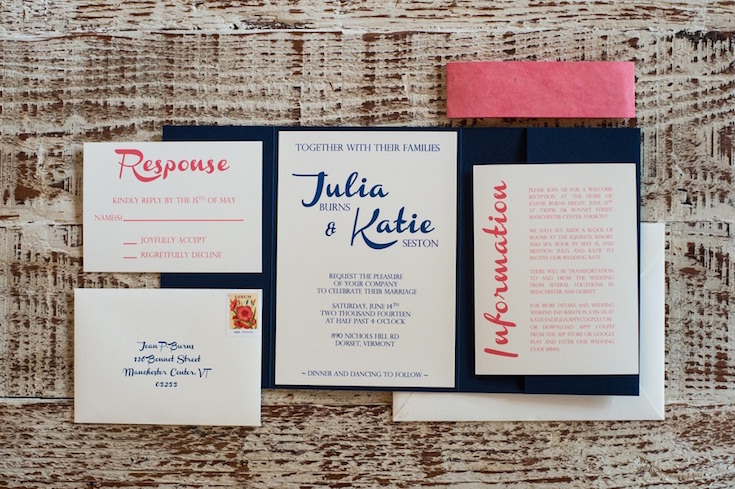
Professional Titles
- The professional titles of doctor (medical only), a commissioned military officer and judge outrank social titles, thus always appear first. Example: Captain Jessica Forsyth and Mr. Jason Forsyth
- The only acceptable abbreviations are Dr. and military ranks; however, extra formality calls for them to be spelled out. Oftentimes, the length of the name ends up being the deciding factor.
- If both individuals of a married couple are doctors, you can use The Doctors or Drs., followed by their names. Examples: The Doctors Jason and Brandon Weiss or Drs. Jason and Brandon Weiss
- For married couples with different last names who are both doctors, use each of their full names, female first or alphabetically if same-sex. Example: Doctor Katherine Herman and Doctor Gary Shepherd
- For couples who are both in the military, list by highest rank first. If they are of the same rank, list female first or alphabetically if same-sex. If they have different last names, include the last name with each individual. Example: Lieut. Francis DeBois and Capt. Jacob Faulk
- It can get tricky if the couple has two different professional titles. If you have some seriously impressive friends, generally the female goes first or list alphabetically if they are same-sex with a shared last name (if not, alphabetically by their last name).
Children
- Kids over the age of 18 but who still live in their parents’ house should receive their own invitation.
- Children under the age of 18 are listed with the parents but only on the inner envelope. Tradition calls for boys under 8 to be listed as Master and over the age of 8 as Mr. while girls under the age of 18 are referred to as Miss. However, if the child does not identify with their birth-assigned gender, your use of abbreviation for them should respect them for who they are. If you’re unsure, ask their parents or simply list their name!
Widows and Divorcees
- Widows are Mrs.
- If a divorced woman kept her married name, you can use Ms. or Mrs. but be sure to spell out her first name. Tip: It’s best to find out her preference beforehand!
When a Man Is a Junior
- For a more formal route, write out “junior” and always use a comma and lowercase. If abbreviated (which is also acceptable), use an uppercase. Examples: Mr. Gregory Carter, junior or Mr. Gregory Carter, Jr.
- Distinctions such as II and III do not involve a comma. Example: Mr. Charles Hancock III
Modernize It!
We understand that not every wedding (or couple) has the same level of formality. While etiquette is important, the invite should still reflect your personalities, relationship and wedding day.
- Not at all close with your friend’s husband? We love the idea of listing the person you’re actually friends with first as a less conservative option!
- If you’ve never uttered the name “Thomas” in reference to your buddy Tom (and you’re not throwing a black tie soiree), don’t feel pressured to use his formal name.
Identity Trumps Tradition
If your masculine-of-center friend doesn’t identify with the gender-driven abbreviations of Mr. or Ms., simply list their name. Respect is key!
**This article originally appeared in Love Inc.’s V3 issue
Wedding Invitation Addressing FAQs
Do you use Mr. and/or Mrs. on wedding invitations?
You can, but you don’t have to. Traditional etiquette calls for “Mr. and Mrs. John Smith,” but modern couples often prefer “John and Sarah Smith” or simply using both full names. Use honorifics if your guest prefers them, skip them if your crowd leans casual.
How do you address a wedding invitation to a same-sex couple?
List both names alphabetically by first name, separated by “and,” OR if you’re much closer to one person vs. the other, use the one you’re closest to. For a married same-sex couple sharing a last name: “Mr. Adam and Mr. Bradley Jones” or “Mrs. Jessica and Mrs. Taylor Reid.” For couples with different last names, list them on separate lines. Honorifics are optional.
How do you address a wedding invitation to an unmarried couple living together?
List both names on the same line, separated by “and” — typically the person you’re closer to comes first. Example: “Ms. Jamie Rivera and Mr. Dan Cho.” If they share a home but aren’t married, skip the hyphenated “Mr. and Mrs.” format entirely.
How do you address a wedding invitation to a nonbinary guest?
Use the honorific your guest prefers. “Mx.” (pronounced “mix”) is the most common gender-neutral option. If you’re not sure, ask, or simply skip the title and use their full name: “Alex Morgan.” Always default to respecting your guest’s stated preference.
Do both partners get their own line on a wedding invitation?
Only if they have different last names, or if one or both have professional titles (like Dr.) that require more space. Couples sharing a last name typically fit on one line: “Mr. and Mr. John Smith” or “John and Jacob Smith.”
How do you address a wedding invitation to a family with children?
On the outer envelope, address it to the parents only: “Mr. and Mrs. John Smith.” On the inner envelope, list each invited child by first name below the parents’ names: “John and Sarah / Emma, Liam, and Noah.” This clearly communicates who is invited.
How do you indicate a plus-one on a wedding invitation?
On the inner envelope, write the guest’s name followed by “and Guest” — for example, “Ms. Taylor Chen and Guest.” If you know the plus-one’s name, use it instead: “Ms. Taylor Chen and Ms. Jordan Blake.” Named plus-ones feel more thoughtful.
Should you spell out titles like Doctor on wedding invitations?
For formal invitations, yes, spell out “Doctor,” “Reverend,” “Captain,” and other professional or military titles in full. For semi-formal or casual invitations, abbreviations (Dr., Rev., Capt.) are fine.
How do you address wedding invitations to a divorced or widowed guest?
For a divorced woman, use whichever last name she currently uses (maiden or married) and “Ms.” unless she’s told you otherwise. For a widowed woman, traditional etiquette uses “Mrs. John Smith” (her late husband’s name), but many widows prefer “Mrs. Sarah Smith” (her own first name). When in doubt, ask.
Do you hand-write or print addresses on wedding invitations?
Both are acceptable, and both are widely used today. Hand-calligraphy feels most formal and traditional; printed envelopes (in a calligraphy-style font) are cost-effective and still look polished. If writing by hand, use a good-quality pen and take your time or hire a calligrapher for anywhere from $1.50 to $6 per envelope.

